

Lot n° 7
Estimation :
1000 - 1500
EUR
Result
: NC
[Manuscript]. [Cartusian Gradual. 17th century]. GRADUALE CA - Lot 7
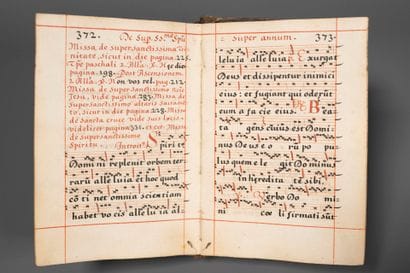
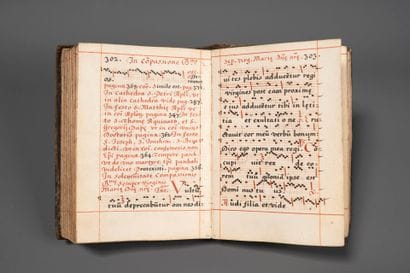
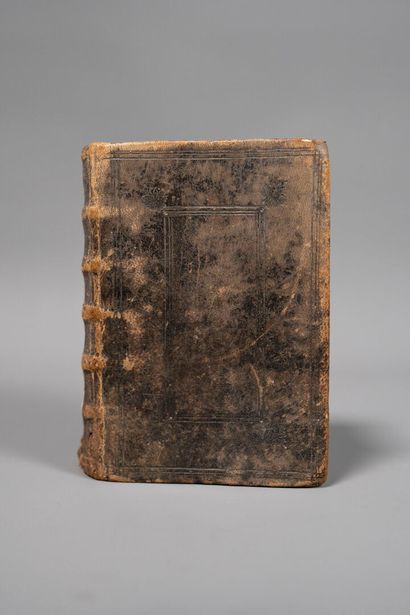
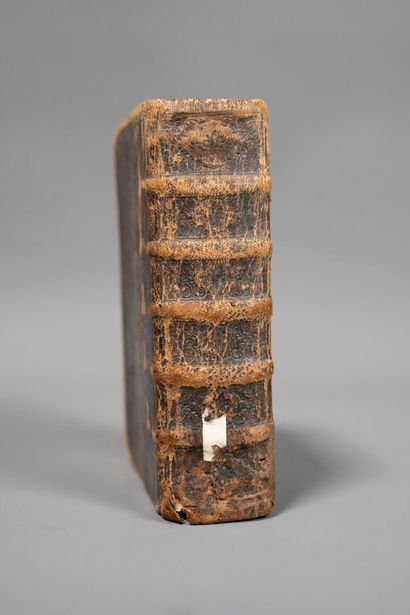
[Manuscript]. [Cartusian Gradual. 17th century]. GRADUALE CARTUSIENSE. Pro domo maciliensi B[eatissi]me Se[m]p[er] Viriginis Marie. [1670]. Large in-4 (approx. 18.5 x 12.5 cm., writing area 147 x 91 mm. including running title), contemporary black basane, spine with 5 muted nerves, coffered boards decorated with cold irons, Duseuil-style cold decoration on the boards, speckled edges (binding rubbed, accident to the tail cap, discreet worm spots at the tail of the spine. Manuscript in ink on strong laid paper. It consists of [2] blank f., [1] title f., 421 numbered pages and [2] blank f., all ruled in red ink. The text proper ends on p. 407 with a mass for the dead, followed by a page and a half with music; pages 411 to 421 are blank. A fragment of printed antiphonary inserted between p.276 and 277. Staves drawn in red, text in red and black with large initials in red, notation in black. The date 1670 was formerly inscribed in pencil on the title page, which is framed in red ink and appears to have had a vignette glued in the center, no longer in existence. The Carthusian monastery was established in Marseille on the initiative of the wealthy Carthusian monastery of Villeneuve-lès-Avignon; construction began in September 1633. It wasn't until around 1680 that construction began on the church, which was consecrated in 1702 and remains the only surviving building of the monastery in Marseille's fourth arrondissement. The Cartusian liturgy differs from the Roman liturgy in its simplicity, and has been preserved unchanged from its conception by St. Bruno in the 11th century until the Second Vatican Council. Thus, this 17th-century gradual reproduces an identical liturgy in use since medieval times. It is characterized by numerous interspersed periods of silence, the banning of all musical instruments, sober Gregorian chant and the absence of polyphony, and almost all the sung texts are scriptural. (Cf. www.chartreux.org/domus/ [and] /moines/laliturgie). Provenance: Congrégation des Oblats de Marie-Immaculée, founded in Aix-en-Provence on January 25, 1816 by Saint Eugène de Mazenod (1782-1861), a priest of the diocese of Marseille (stamp repeated on title).
My orders
Sale information
Sales conditions
Return to catalogue