

Lot n° 20
Estimation :
4000 - 6000
EUR
Result with fees
Result
: 18 560EUR
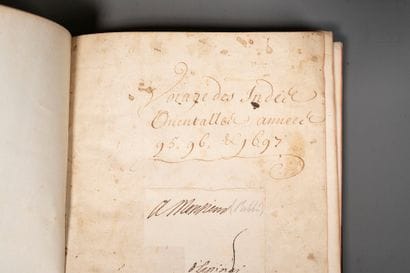
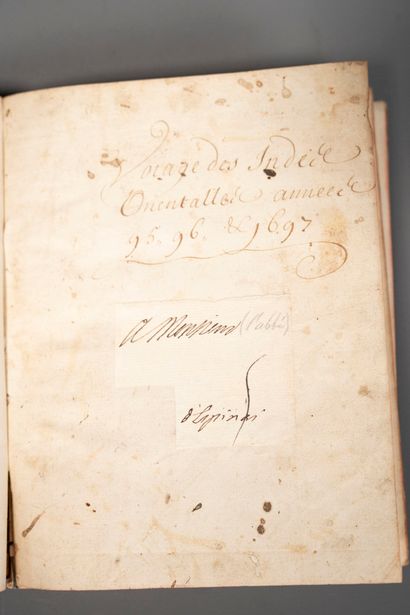
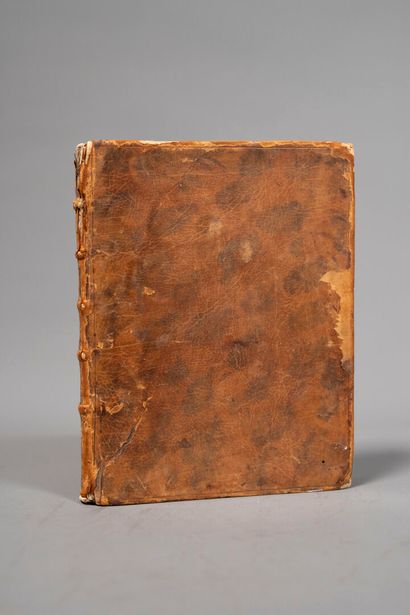
[Manuscript]. [Voyage aux Indes]. VOIAGE DES INDES ORIENTALL - Lot 20
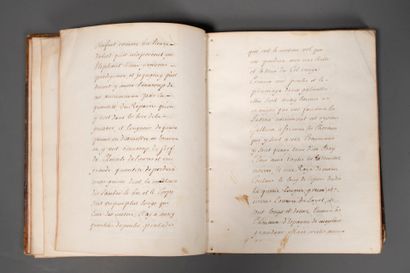
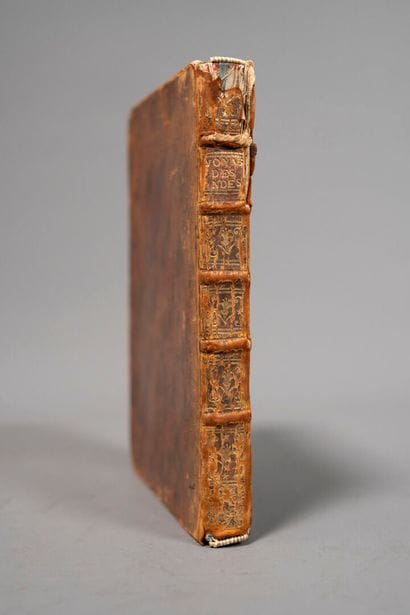
[Manuscript]. [Voyage aux Indes]. VOIAGE DES INDES ORIENTALLES annees 95, 96 & 1697. S.l., s.n., [circa 1700]. In-4 (218 x 170 mm.), contemporary havana calf, 5-ribbed spine, havana title page, red edges (flaws including worn spine with gap at head and uncovered headpieces, worn corners, distended seam; title soiled, light spotting at very beginning of vol, Composed of [118] leaves including the title, written in ink on laid paper, recto and verso, in one column with wide lateral margins, by the same hand which seems to have written several quires in succession. There are no apparent gaps, and the text appears to be continuous despite a few blank pages. This is an exceptional original account of an expedition for which we have only indigent historical sources. On December 22, 1694, a ministerial dispatch commissioned Captain Guillaume d'Aché, comte de Serquigny (c. 1647-1713), to take command of the squadron sent to Asia, comprising three king's ships, the Zélande, the Faucon and the Medemblick, and three merchant ships. On his return, Serquigny submitted to the Minister only a very brief report of his voyage, preserved in the Archives de la Marine (ANF, Marine B4 17, f. 423- 433), and to our knowledge, no other participant in this expedition has left any account of it. We have found no copy of a similar account in the online catalogs of public collections, and no trace of an edition. The author of this account, who remains anonymous, is a clergyman, whom it might be possible to identify. We do not know if he is the editor of this copy. The text is full of precise details, unpublished historical facts and sometimes highly critical personal considerations. It takes the form of short chapters or paragraphs preceded by a title. After an introduction setting out the purpose of the voyage "for three purposes, to deliver our vessels blocked in Bengal, to re-establish the almost ruined trade in Surate, and to load salpetre in this country", the parts are as follows: Departure from Rochefort; Description of Port Louis; Departure from France; Description of the Canaries; Arrival at Cape Verd; Description of Gorray; Description of Cape Verd; Departure from Cape Verd; Passage of the line and the ceremonies observed; Cape of Good Hope; Description of the sea wolves; Scurvy and its causes; Description of the isle of Moely; Their pagoda or temple; Their way of life; Coconut and sea chestnuts; Sailor who fell overboard; Séparation du Pontchartrain ; Description de l'isle d'Anzuan ; Description d'une pagode ; Description de leur cimetiere ; Leurs adorations ; Départ de l'ilse d'Anzuan ; Comette ; Arrivée à la rade de Goa ; Description de la ville de Goa ; Description de l'église des Theatins ; Jardin ; Description de l'église de la maison professe où repose le corps de saint François Xavier ; Description de l'église métropolitaine ; Des officiers de Goa ; Départ de la rade de Goa ; Arrivée à la rade de Suratte ; Proposal made to our commander (by the Grand Mogol); Description of the city of Suratte; Suratte merchandise; Various religions; Their way of learning to write; Preaching; House of the Anglois and Dutch; Habits of the locals; Suitte du gouverneur de Suratte; Sortie de la rade de Suratte; Seconde arrivée à la rade de Goa; Réunion de nos trois vaisseaux; Départ de la rade de Goa; Rencontre de l'escadre hollandoise; Combat des Isles brulées ; Réflexions ; Seconde arrivée à Suratte ; Supplément de la description de Suratte ; Des éléphans ; Des magiciens ; Description de Sualis ; Infame métamorphose d'un prince siamois ; Départ de la rade de Suratte, et de l'Inde ; Voyage de Bengal rompu ; Prevoyance nuizible ; Ruse des hollandois découverte ; Conseil tenu dans ce moüillage ; Arrivée à l'Isle Bourbon ; Mœurs et vies de ces insulaires ; Départ de l'Isle Bourbon ; Eclipse de lune ; Description de la [ville ?of St Salvador scituée à la Baye de tous les Sts; Description d'une procession généralle; Départ du Brésil; Séparation du Fleurissant; Prise d'un v[aisse]au Espagnol. Finally, on the title and last leaf, there are two old handwritten notes, cut and pasted, bearing the name of a certain Abbé d'Espinai, a later note suggesting that the manuscript had been offered by the author to this Abbé.
My orders
Sale information
Sales conditions
Return to catalogue